

Look at almost any grand government building in the United States, from the Supreme Court to countless state capitols and courthouses, and you are looking at Greek Revival architecture. But this style was never just for public monuments. For roughly three decades in the early 19th century, it was the dominant way that ordinary Americans built their homes, their banks, their churches, and their schools. It became so ubiquitous that it earned a rare distinction: it was called the National Style.
Today, Greek Revival architecture continues to captivate homeowners, designers, and history enthusiasts alike. Whether you live in a period property, are drawn to the grandeur of classical columns, or simply want to bring a sense of timeless elegance into your home, understanding this style is the first step. This guide covers everything: where it came from, what makes it look the way it does, and how to apply its principles in a modern home.
Where Did Greek Revival Architecture Come From?
To understand Greek Revival, you have to go back to ancient Athens. The buildings of 5th-century BC Greece, particularly the temples of the Acropolis, represented something extraordinary: a system of architecture built on mathematical precision, harmonious proportion, and an ideal of human reason made visible in stone. The Parthenon, completed in 438 BC, remains one of the most studied buildings in history.
For centuries, access to Greece was limited and these buildings were known mostly through Roman descriptions and secondhand accounts. That changed in the mid-18th century when British architects James Stuart and Nicholas Revett made the journey to Athens and produced a meticulous measured survey published as The Antiquities of Athens (1762). For the first time, architects had accurate drawings of the Doric and Ionic orders as they actually existed. The Greek Revival movement was born from those pages.
The style caught fire first in Britain, then spread rapidly to the United States, where it found a uniquely receptive audience. The timing was perfect. America had recently won its independence, its democracy was new and fragile, and its citizens were searching for architectural symbols that expressed their national identity. Ancient Greece, the birthplace of democracy, provided exactly that. Pattern books by architects such as Asher Benjamin and Minard Lafever spread Greek Revival designs across the country, making the style accessible to builders and homeowners far beyond the major cities.
What Are the Key Features of Greek Revival Architecture?
Greek Revival is one of the most recognisable architectural styles in America. Its features are bold, deliberate, and rooted in a clear visual logic. Once you know what to look for, you will see it everywhere.

The Columns
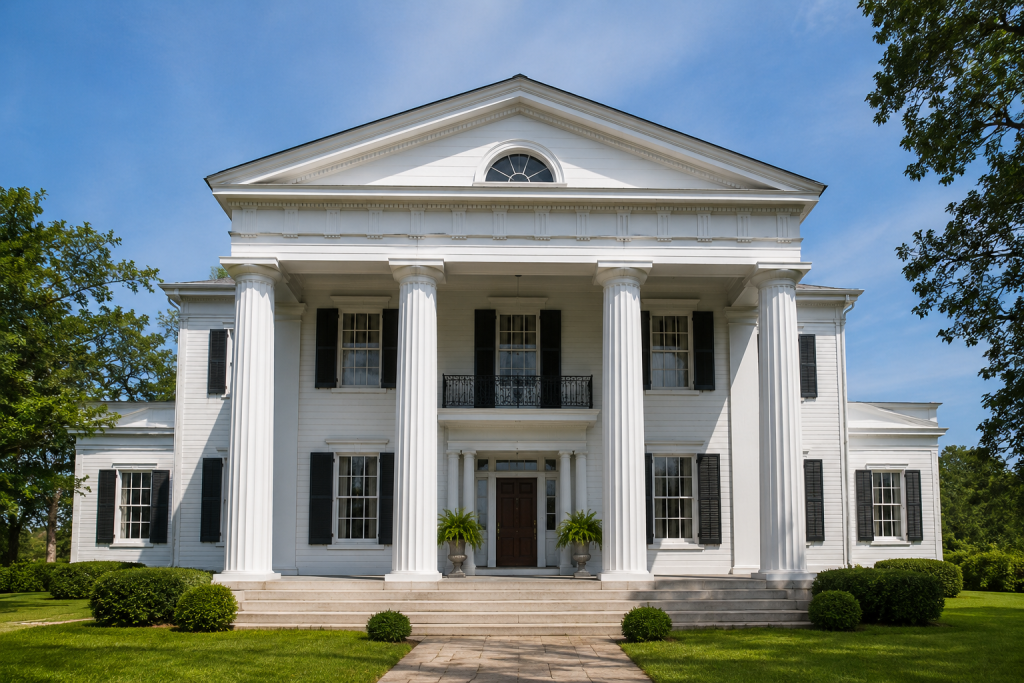
No feature defines Greek Revival more completely than its columns. They are the first thing you notice and the element that sets the entire tone of a building. In residential architecture, columns typically appear at the front of the home, supporting a portico or spanning the full width of the facade. They come in three classical orders, each with a distinct character.
The Doric order is the oldest and most restrained, with plain, unadorned capitals and a powerful, slightly tapered shaft. It projects strength and dignity, and it is the most common order found in American Greek Revival homes. The Ionic order is more slender and refined, distinguished by the spiral scroll decorations (called volutes) on its capitals. The Corinthian order is the most decorative of the three, with capitals carved to resemble bundles of acanthus leaves. It appears most frequently on grand public buildings and the most elaborate private residences.
The Pediment and Entablature
Above the columns sits the entablature, the horizontal band that connects them, consisting of the architrave at the base, the frieze in the middle, and the cornice at the top. On a Greek Revival home, the frieze is typically left plain or decorated only with simple dentil moulding, a row of small rectangular blocks that recall the beam ends of ancient timber construction. Above the entablature, the roofline forms a low-pitched triangular shape called the pediment. This is the most temple-like element of the exterior, and it faces the street, announcing the building’s classical aspirations from a distance.
The Exterior Walls and Colour
Greek Revival homes are almost always white, or very close to it. This is partly a practical matter: most American examples were built from wood or stucco rather than marble, and white paint created the closest visual resemblance to the stone buildings of ancient Athens. There is a historical irony here worth noting. The temples of ancient Greece were not white. They were painted in vivid reds, blues, and golds. But by the time 19th-century architects studied the ruins, the paint had long since worn away, leaving only gleaming marble. The revival style was built on a beautiful misunderstanding, and the crisp white palette became one of its most enduring characteristics.
The Roof and Overall Form
The roofline of a Greek Revival home is deliberately understated. Unlike the steep, dramatic roofs of Gothic or Victorian architecture, Greek Revival roofs sit low and flat, typically as a gable or hip roof with a very gentle pitch. This restraint is intentional. The roof should not compete with the columns and pediment below. The eye is meant to travel across the facade horizontally, reading the temple form, not be pulled upward by a soaring roofline. Dormers, when present, are given simple pedimented hoods that echo the main facade’s classical vocabulary.
Windows and the Front Door
Windows in Greek Revival homes are tall, double-hung, and evenly distributed across the facade in a symmetrical arrangement. They typically have six panes of glass per sash and flat, unornamented surrounds that maintain the clean, linear quality of the exterior. The front door is always a focal point. It often features a transom window set into the frieze above, sidelights flanking the door itself, and a surround of pilasters and a simple entablature. The effect is formal, welcoming, and unmistakably classical.

What Does a Greek Revival Interior Look Like?
The grandeur of Greek Revival does not stop at the front door. Inside, the same principles of symmetry, classical proportion, and restrained elegance carry through to every room. A Greek Revival interior is one that feels ordered and spacious, with architectural details that reward close attention.
Ceilings, Cornices, and Mouldings
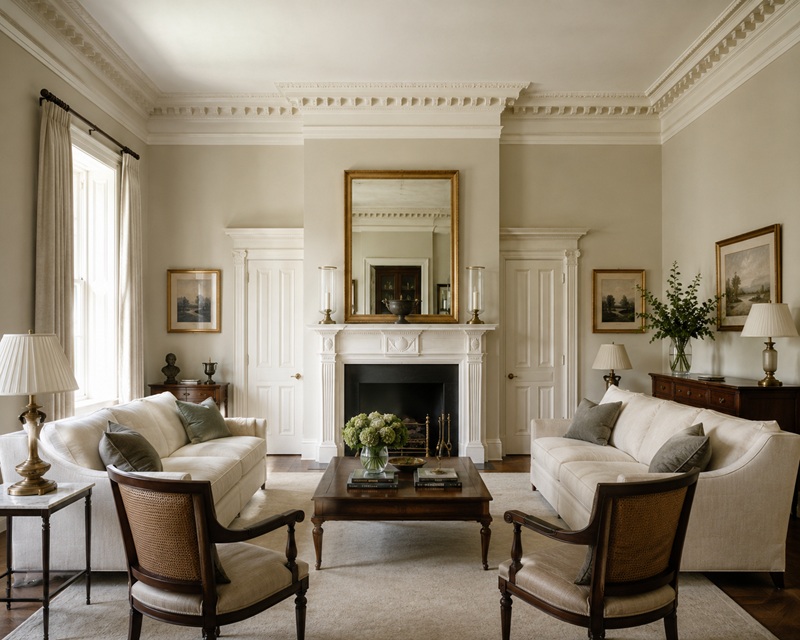
Greek Revival interiors are defined by their architectural detailing. Ceilings are high, typically 10 to 12 feet, creating a sense of grandeur that smaller rooms cannot replicate. The transition between wall and ceiling is handled by a cornice, often featuring dentil moulding, egg-and-dart detailing, or a plain classical profile. These mouldings are not merely decorative. They are the interior language of the style, connecting the room to the classical tradition with the same logic that governs the columns outside.
The Parlour and Formal Rooms
The formal parlour is the heart of a Greek Revival home. In the finest examples, an Ionic columnar screen separates the entrance hall from the main reception room, framing the space with a sense of ceremony. Walls are smooth-plastered and painted in warm, neutral tones, typically a soft beige or warm white. A black marble fireplace anchors one wall, with furniture arranged symmetrically around it. The Metropolitan Museum of Art’s recreated Greek Revival parlour, modelled on a fashionable New York City townhouse of around 1835, captures this atmosphere with striking precision: deep red silk-upholstered furniture, a patterned carpet in red and gold, and a black marble mantelpiece as the room’s undisputed focal point.
Greek Revival Furniture
Greek Revival furniture belongs to the Neo-Grec tradition, which was at its height in the early 19th century. Two pieces are particularly associated with the style. The klismos chair, with its gently outward-curving legs and curved backrest, is a direct reference to ancient Greek seating seen in vase paintings and sculptures. The asymmetrical daybed or chaise longue, with a raised back at one end, was another fashionable piece that allowed its owner to recline in a posture that consciously echoed classical Greek repose.
Cabinetmaker Duncan Phyfe was the most celebrated furniture maker of the period in America, and his workshop produced some of the finest examples of Neo-Grec furniture in the country. His pieces are characterised by restrained elegance, fine mahogany veneers, brass hardware, and classical motifs including lyres, acanthus leaves, and Greek key patterns.
Interior Colour in Greek Revival Homes
The interior palette of a Greek Revival home is warmer and richer than the stark white exterior might suggest. Paint analysis of surviving period interiors in New York, including the Colonnade Row townhouses built in 1832, reveals that walls were painted in warm beiges, soft ochres, and creamy whites rather than cold, clinical whites. Against these neutral walls, accents arrived through textiles: deep red, gold, and black were fashionable colours for carpets, drapery, and upholstery in the grandest Greek Revival parlours.
For those decorating today, the palette that suits a Greek Revival interior best combines crisp white architectural elements (cornices, mouldings, window surrounds, fireplace surrounds) with warmer wall tones and bold accents in the soft furnishings. Ivory, warm linen, faded terracotta, Mediterranean blue, and deep forest green all work well within this framework.
Regional Variations Across America
Greek Revival spread across the United States faster than any architectural style before it, carried westward by pattern books and by settlers, particularly New Englanders, who brought the style with them as they moved into upstate New York, the Midwest, and eventually the West Coast. As it spread, it adapted to local conditions, materials, and traditions.
- In New England, Greek Revival appeared as the classic white clapboard cottage with a pedimented front gable and simple pilasters framing the door. These modest one-and-a-half storey examples, sometimes called Classic Cottages, are among the most charming expressions of the style.
- In the American South, the style reached its most spectacular expression on plantation manors, where full-length porticos with rows of giant columns created the iconic image of the antebellum South. These grand estates used the classical language of freedom and democracy in a deeply contradictory context, a tension that is part of the style’s complicated legacy.
- In New York City, Greek Revival townhouses were built in rows along fashionable streets, their unified facades creating an effect of classical grandeur at an urban scale. Washington Square North, completed in the 1830s, remains one of the finest surviving examples.
- In the Western territories, a simplified version known as Territorial Style adapted Greek Revival elements to local construction methods, using square posts instead of round columns and flat porch lines instead of full pediments.
Famous Examples of Greek Revival Architecture
Some of the most significant buildings in American history are Greek Revival masterworks. The Second Bank of the United States in Philadelphia, designed by William Strickland and completed in 1824, is one of the earliest and most influential examples, modelled directly on the Parthenon with its eight-column Doric facade. Andalusia, the country house near Philadelphia designed by Thomas U. Walter for banker Nicholas Biddle in 1835, is widely considered the finest Greek Revival private residence in America.
Beyond the United States, the style made its mark in Britain with buildings such as the British Museum in London (1852) and the Royal High School in Edinburgh (1829). In Germany, Leo von Klenze designed the Glyptothek in Munich (1830), a temple-fronted museum that remains one of Europe’s finest Greek Revival buildings. The style also had a brief but vivid flowering in Russia, where Alexander I commissioned a sweeping Greek Revival reconstruction of the historic centre of Saint Petersburg.
[IMAGE: A famous Greek Revival landmark — the Second Bank of the United States (Philadelphia), the British Museum (London), or a well-known Greek Revival plantation house. Use a high-quality architectural photograph that clearly shows the Doric columns and pediment.]
How to Bring Greek Revival Style Into Your Home Today
You do not need a neoclassical mansion to live with Greek Revival style. The principles that made this architecture so compelling in the 1830s, clarity of form, classical proportion, restrained elegance, and the quiet authority of white against the landscape, translate naturally into contemporary homes. Here are the most effective ways to introduce the style:
- Install dentil crown moulding in living rooms and hallways — it is the single most impactful step toward a classical interior
- Add pilasters (flat-faced columns) flanking doorways or as a feature on a blank wall
- Choose a fireplace surround in white or black marble with a simple classical profile
- Use a Greek key pattern in borders, rugs, tiles, or cushions as a recurring motif
- Paint woodwork, mouldings, and window surrounds in crisp white against warmer wall tones
- Arrange furniture symmetrically, especially in formal rooms, with matching pieces on either side of a central axis
- Look for klismos-inspired chairs with curved backs and outward-sweeping legs for a direct classical reference
- Use tall, slender lamps or candelabras to echo the verticality of Greek columns
- Choose curtains with simple, classical valances rather than elaborate swags or fussy trims
Why Did Greek Revival Fall Out of Fashion?
By the 1860s, Greek Revival had begun to fade. The American Civil War shattered the optimistic national narrative that had given the style so much of its symbolic power. New architectural fashions, particularly the Gothic Revival and Italianate styles, offered something that Greek Revival could not: variety, expressiveness, and a break from the strict rules of classical proportion. Victorian architecture, with its picturesque asymmetry and rich ornamentation, was the opposite of everything Greek Revival stood for, and it captured the imagination of a generation ready for something new.
The style never entirely disappeared, however. It was revived again in the late 19th century as part of the Colonial Revival movement, and its influence can be seen in American architecture right through the 20th century, from the neoclassical government buildings of Washington, DC, to the white-columned porticos of suburban homes. Greek Revival is not a historical curiosity. It is a living tradition.
Frequently Asked Questions
What is Greek Revival architecture?
Greek Revival architecture is a style inspired by the temples and buildings of ancient Greece. It flourished in the United States from roughly 1820 to 1860, becoming so popular it was called the National Style. Key features include tall classical columns, a low-pitched gable roof with a prominent pediment, white exteriors, and symmetrical facades.
Why did Greek Revival architecture become so popular in America?
Americans in the early 19th century saw a strong parallel between their young democracy and the ideals of ancient Greece, where democratic government was born. This cultural identification, combined with the simple lines of the style and accessible pattern books that spread construction guidance widely, made Greek Revival the dominant architectural style across the country for several decades.
What are the three column orders used in Greek Revival buildings?
Greek Revival buildings use three classical column orders derived from ancient Greece. The Doric order is the simplest and most powerful, with plain, unadorned capitals. The Ionic order features scroll-like decorations called volutes at the top of each column. The Corinthian order is the most elaborate, with capitals decorated with carved acanthus leaves. Doric columns are most common in American Greek Revival homes.
How is Greek Revival different from Neoclassical architecture?
Greek Revival draws exclusively from ancient Greek sources, particularly the Doric and Ionic orders, and tends to be bolder and more monumental in character. Neoclassical architecture is a broader term that incorporates both Greek and Roman influences. Greek Revival is considered the final phase of the Neoclassical movement, but it is more restrained and specifically temple-inspired than earlier Neoclassical styles.
Can Greek Revival style work in a modern home?
Yes. You do not need a historic property to bring Greek Revival into your home. Key elements such as classical columns or pilasters, dentil crown moulding, symmetrical layouts, a statement pediment above a doorway, and a restrained white and neutral colour palette can all be introduced in a contemporary setting to capture the essence of the style.
Final Thoughts
Greek Revival architecture endures because it is built on ideas rather than trends. It was never just about columns and white paint. It was about what those columns represented: the belief that a society could aspire to the clarity and order of ancient Greece, that a home could be both beautiful and rational, and that architecture could carry meaning beyond its four walls. Those ideas are as compelling today as they were two centuries ago. Whether you are standing before the Parthenon, admiring a row of white clapboard houses in a New England village, or simply adding dentil moulding to a living room ceiling, you are participating in one of history’s great architectural conversations.